Hello, I am student taking design and technology for A-level. I have decided to make a wood gasifier camping stove for my final project and I am required to do some research into the area. I have been camping several times with my family, but we've only ever used one or two different gas camping stoves.
I would like to ask what kind of things do you need from a camping stove? Which aspects of it's design are most important to you? For example is portability the main feature that you would consider before buying one of these products.
Also, which particular stove do you prefer to take with you currently on camping trips and why?
Finally, have you actually come across a gasifier of some form in the past? If so what was your experience with it and would you prefer to use that over a typical gas stove?
Any other information you could give me would be greatly appreciated! Thanks in advance.
My most important things in a camping stove are:
Able to use 2 saucepans at the same time (how else can you get the beans and bacon...)
Controllability of cooking temperature (don't want thing boiling over)
Able to use at any height
Self levelling (getting fed up of sticking things under stove when pitch isn't level)
Portability (needs to fit in small space in car and not weigh a tonne)
Easy set up (don't want to wait ages for first cup of tea)
Able to use 2 saucepans at the same time is the main feature for me. Then of course there is the convenience of transport and use, and the price. But the first characteristic (as mentioned also by Carol) is fundamental
Most people here will know them as a rocket stove I think. ;-)
What they all said plus...
Will it have enough Btu's to boil a kettle in a reasonable amount of time (5 mins?)
Will this be small enough to be transportable?
As I understand you need to control (limit) the amount of oxygen to the chamber with the fuel in to achieve the gasification? How are you going to achieve acurate enough control? How accurate does it need to be? Are you going to calculate the air flow or go by trial and error?
I have a number of stoves, backpacking and family camping one ring and two ring versions. What's most important for me is pack size, cost of fuel, overall design, i.e. are the stable, feel well built, can fit two pans, will it be reliable.
It sounds a really great project and if you need any feedback on the design feel free to check back in. Not that I've actually made one, but have a reasonable grasp on the physics/ maths.
This is quite some project.
You want to place a portable town gas works outside every tent.
Town gas was mostly carbon monoxide which is poisonous. The poet Silvia Platt and many others committed suicide by sticking their heads into town gas ovens.
There have been deaths in tents from using charcoal grills (bbqs) in the confined space of a tent. Burning charcoal produces carbon monoxide when denied enough air.
I want a lightweight gas stove, that I can control and is safe. I accept the risk of setting fire to my tent with a flame that I can see, I do not want a colourless odourless gas loose in my tent that could kill me in my sleep.
Thanks for the responses!
I think for the timespan and workload I have for this project I will be working by trial and error for the actual product. As for my design portfolio (which I have to produce alongside the final build), I will include brief information about the physics behind the gasification process.
Quote: Originally posted by Bramston on 10/7/2014
This is quite some project.
You want to place a portable town gas works outside every tent.
Town gas was mostly carbon monoxide which is poisonous. The poet Silvia Platt and many others committed suicide by sticking their heads into town gas ovens.
There have been deaths in tents from using charcoal grills (bbqs) in the confined space of a tent. Burning charcoal produces carbon monoxide when denied enough air.
I want a lightweight gas stove, that I can control and is safe. I accept the risk of setting fire to my tent with a flame that I can see, I do not want a colourless odourless gas loose in my tent that could kill me in my sleep.
In the scenario that gas is loose inside a tent, would butane not also be toxic? Thanks for drawing my attention to this though, perhaps if I made the stove fairly small large enough for one or two pans maximum it would produce less of a hazard (just a thought)? The design i am planning will be similar to other camping stoves that run on wood chips, with the gas being burned off pretty much as soon as it is produced.
Butane and propane are non toxic but do not support life.
These gases are heavier than air and could replace oxygen close to the ground. But as with North Sea Gas, methane, there is a greater danger of explosion than of suffocation. Methane suffocation has occurred in underground locations such as sewers and mines.
Carbon monoxide attaches itself to haemoglobin in the blood when it is inhaled. The haemoglobin is unable to lose carbon monoxide. If you were to breathe a mixture of air and carbon monoxide you would find yourself unable to use the oxygen in the air as your haemoglobin gets clogged up with CO.
There's already a couple of wood gasifiers on the market - take a look at 'Wildstoves' online & there's already a model called 'The Woodgas Stove'.
I've used one & they're fine & have their devotees on most bushcraft forums - you may like to contact them as they are the ones who camp a little more on the 'wild' side. Every woodgas stove I've seen has been a one potter though.
The main problem with these is fuel - if there's not a ready supply to hand then you're carrying it. If I have to carry fuel I'd use a more efficient cooking system eg liquid fuals that last longer & generate more BTUs. I'm a bit of a dinosaur & use Trangias & paraffin stoves.
Just bought this stove from Wild Stoves and used it last week.
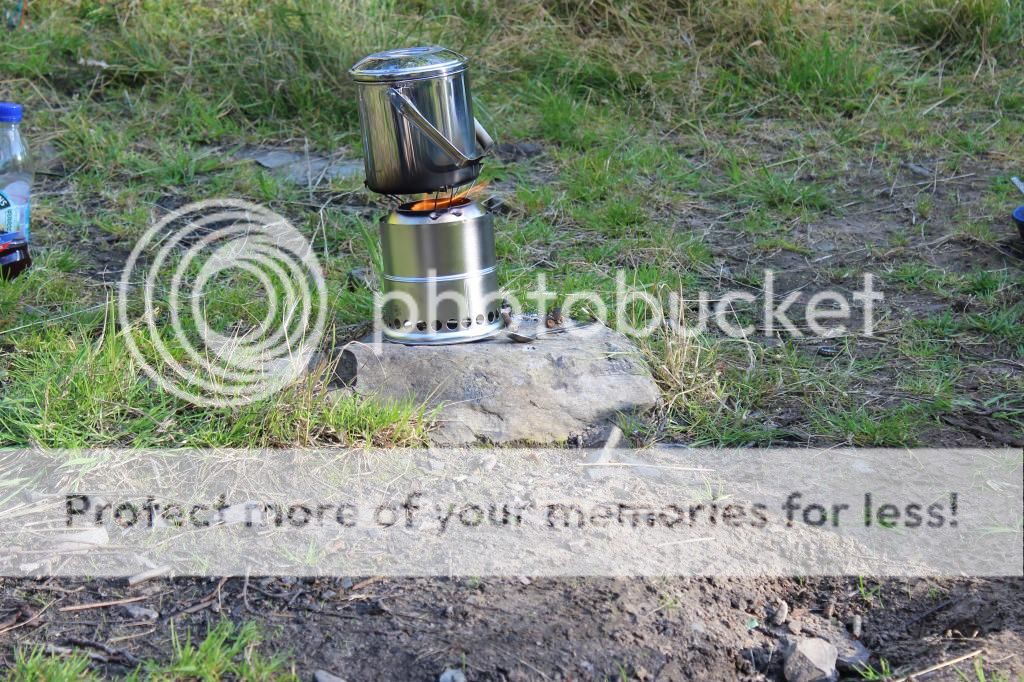
I wanted something light and portable for wild camping/walking. I also liked the idea that it can run on a number of different fuels. So far I must confess that I've only used it with the Trangia meths burner for convenience (hence the sooty pot) and that worked well but I have yet to try it out with wood to see the 'secondary burn' effect.
I tried a hexamine/esbit tablet too but it burnt out in two minutes without heating anything, so not impressed. The wind was blowing strongly though, so maybe that's the reason.
For regular camping this would be too small. My preference is for my petrol stove with two burners as it works well in the wind and low temperatures.
Hello there,
I have recently bought a camping stove for a great deal with a local company in Lancashire. We went and bought it from the factory and got a discount. They pulled one out into the yard and very kindly lit it for us to show us how it ran. we now take it camping with us and use it for our food but also as a campfire. this comes in handy because many of the campsites we visit do nor allow open fires. I understand that this is a little off-track but this stove has a gasification system built into the design. Might be worth a look. you might be able to steal a few ideas.
Quote: Originally posted by armchaircamper on 18/7/2014
. So far I must confess that I've only used it with the Trangia meths burner for convenience (hence the sooty pot).
try adding 10% water to your meths that will drastically cut down on the soot.
Mind you having said that if you are going to burn wood then you will get sooting anyway.
I have a wood gasifier, which I hardly ever use, the real thing that needs a bit more thought is the gasification process, in all the models I have seen it is a passive system just relying on drawing fresh air in.
If there were some way to get the secondary burning roaring that would vastly improve boil time. or maybe a method of containing the flames somehow.
I stayed on a boat years ago that had a secondary oxygen inlet which caused secondary burning under the top plate of burner allowing a kettle to boil quicker on the top. Maybe something along those lines might work.
A day of all things motorhome and campervan. The show is held both in the main indoor arena and across the grounds. Catering, hot drinks and food options are available. Easy access to the site and free parking included. Win one of five pairs of day tickets



 Topic: Camping Stoves